
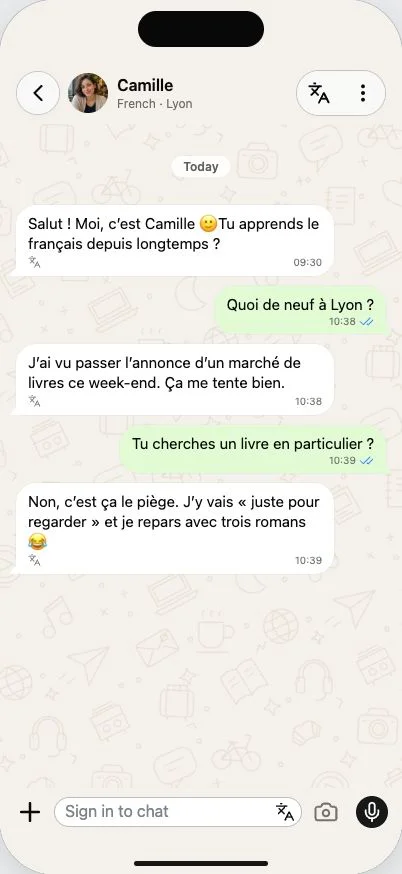
Give the conversation somewhere to go
Language practice with real-world topics can begin with a place or an interest you already care about. Ask what is happening around the character’s city, talk about books or food, or follow a thread from its day. A concrete subject gives you something to react to beyond a standard greeting.
Merdi characters have a location, background and interests. Saved world snapshots can provide local, national and work-related context for those settings. When a relevant report is available, the character can use it in a reply. You can ask what an expression means, give your opinion or compare it with life where you live.
Two kinds of context
World events and personal events do different jobs. World snapshots keep sourced reports and their dates. Personal memories keep the character’s fictional experiences, shaped by its background, relationships and surrounding context.
A bookseller might have a story about a morning in the shop. A travel-minded character might have a plan involving friends. These details provide continuity for language practice. You can ask about the shop again tomorrow, remember the friend’s name or find out how a plan turned out.
Follow the topic that interests you
You do not need to read a full article to have a useful exchange. One detail is enough: a local event, something connected to a hobby, or a small experience from the character’s life. Ask a question, explain your view, or describe something similar from your own city.
For a beginner, that might be a short reaction followed by a request for simpler wording. At a more advanced level, it could become a discussion about a familiar industry or an expression used in the news. The goal is to use the language in context, not to memorise a list of headlines.
Fresh context has limits
The character reads saved research; it does not run a new web search for every message. Reports may be dated, a location may have little coverage, and a relevant snapshot may be missing. Publication dates and research dates are different, so recently retrieved information is not necessarily about an event that happened today.
Use this feature as a source of conversation topics rather than a live news service. Check an original source for important facts. If you prefer a lighter exchange, change the subject: the character’s memory of your conversation can offer another place to begin.